
AI Solutions · Oil & Gas
AI Cost Monitoring for Oil and Gas Operators
Catch drilling and completion cost overruns against the AFE while they're still contestable, not at quarter-end.
The Short Answer
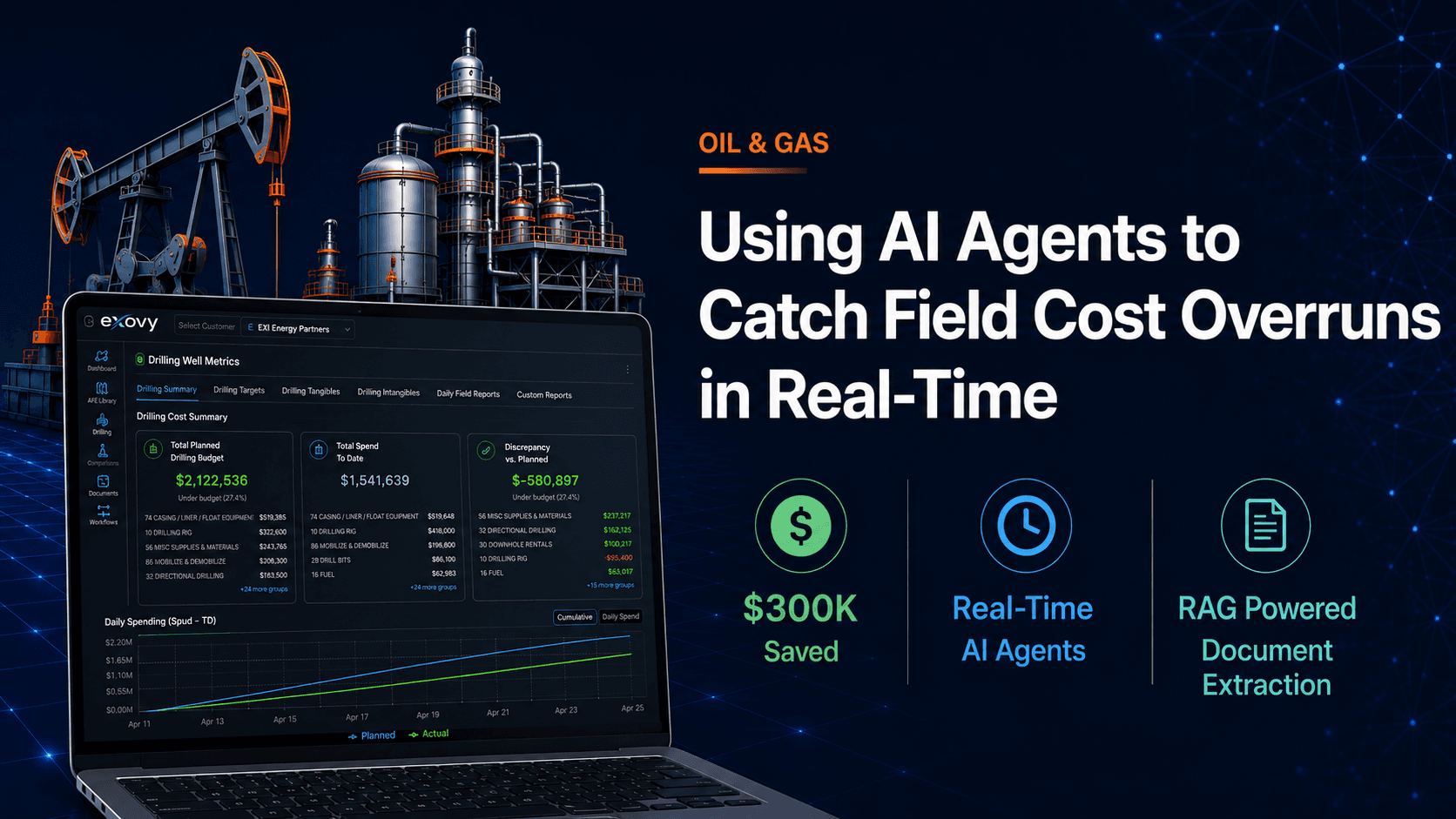
Oil and gas AI cost monitoring uses AI agents to compare actual drilling and completion costs against the authorized AFE as charges post, instead of reconciling at job-end or quarter-end. TechVora deploys eXovy's AI AFE module, grounding every comparison in the operator's own historical AFE data, and on one three-pad program it uncovered roughly $300K in savings before invoices were paid.
Why AFE Overruns Are Found Too Late
The AFE sets the approved budget for a drilling and completion program, but controlling spend against it is the hard part. Costs accrue continuously as wells are drilled and completed, while actuals typically aren't reconciled against the AFE until the job or the quarter closes.
By then invoices are paid and the books are closed, so there's no practical way to dispute a field charge. Discrepancies that could have been challenged in the moment become sunk costs. AI monitoring closes that gap by flagging line-item variances the moment they appear.
How AI Cost Monitoring Works
The AFE as a live baseline
The authorized AFE becomes the control baseline every incoming cost is measured against, line by line.
AI agents watching costs in real time
Agents continuously compare actuals to the baseline as charges post and flag discrepancies and overruns as they emerge.
Grounded in your own well history
Retrieval-augmented generation (RAG) over your historical AFEs makes every flag specific to your operations, not a generic benchmark.
Built on Azure AI
Azure AI Foundry for model orchestration and the agent runtime, with Azure AI Search as the retrieval layer.
How We Work
- 1
Connect
Load authorized AFEs and historical well data, and connect the cost feeds for active programs.
- 2
Baseline
Stand up each AFE as the live control baseline for its program.
- 3
Monitor
AI agents flag line-item discrepancies as wells are drilled and completed.
- 4
Act
Your team challenges charges with vendors while they're still contestable.
FAQs
Frequently Asked Questions
What is AI cost monitoring in oil and gas?
It's the use of AI agents to continuously compare actual drilling and completion costs against the authorized AFE as they're incurred, flagging discrepancies in real time rather than during end-of-job or end-of-quarter reconciliation.
How much can AI cost monitoring save?
Results depend on the program, but on a single three-pad drilling and completion program, real-time AFE monitoring uncovered approximately $300,000 in cost savings by catching discrepancies before invoices were paid.
How is this different from standard AFE variance reporting?
Standard variance reporting looks backward after costs are booked. AI monitoring flags variances while work is still in progress, and because it's grounded in your own historical AFEs, each flag is specific enough to take to a vendor.
What's the relationship between TechVora and eXovy?
eXovy is the oil and gas economic intelligence platform whose AI AFE module powers this monitoring. TechVora deploys and integrates it into operators' existing systems and data.
Who is this built for?
Upstream operators running multi-pad drilling and completion programs, such as mid-size Permian operators, who want to control spend against the AFE during the work rather than after it.
Drive Efficiency, Scale Faster
See AI Cost Monitoring on Your Own AFEs
- 30-Day Flexible Contracts
- Dedicated US-Based Team
- Houston Headquarters